How our solid-state radio frequency (RF) systems turn electricity into precise, controllable industrial heat, and why that means more than just power.
More than just power
Not just kilowatts, controllable, data-rich heat
The core ideas behind solid-state RF, explained simply.
Process data & diagnostics
Live process data for control, validation and repeatability.
Energy resilience
Electric & hybrid-ready, with less gas dependence.
Efficiency & emissions
High efficiency cuts energy use and operating cost.
Platform
One modular platform, from 1 kW to megawatts
Built from standard power modules
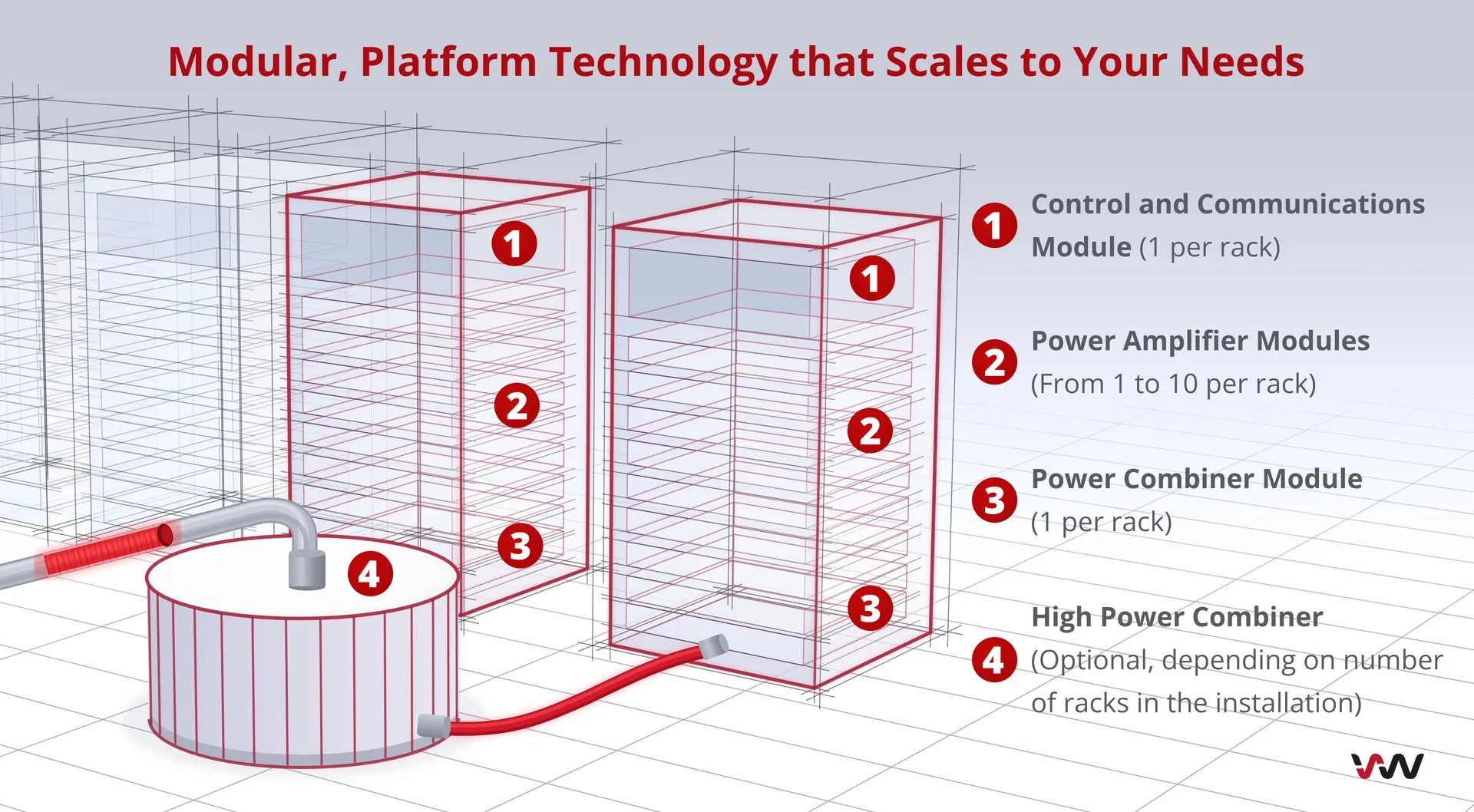
Our solid-state RF systems are built from standard 27.12 MHz power modules, stacked in 19-inch racks. A common control and communications module manages every amplifier in its stack, and multiple stacks combine to reach megawatt power levels.
The power from all modules is merged in a power combiner of our own design and delivered to the process through our application matching network. It couples the energy into the material with minimal loss, so the heat is generated directly inside the product: fast, uniform and repeatable.
27.12 MHz power modules
1 to 10 power modules per 19-inch rack
One control and communications module per rack
Racks combine to megawatt levels
How it works
How RF heating works
01
Generate
Solid-state RF systems produce clean, precisely controllable power.
At the heart of every SolidWatts system is a solid-state power amplifier. Instead of a vacuum tube, it uses the latest high-power transistors to turn electricity into radio frequency power at 27.12 MHz, a frequency within the permitted European ISM bands.
Each power module delivers 1 kW or 10 kW, with precision RF power control so you can use less than the full output when the process needs it. To scale up, identical modules are added under a common control and communications module, all the way to megawatt levels.
Automatic RF impedance matching couples energy into the material with minimal loss. This is our core IP.
Every material and every applicator has its own impedance, and it changes as the product heats, dries or cures. When the load does not match the generator, energy is reflected instead of being absorbed.
Our matching network sits between the generator and the applicator and fine-tunes the RF so that as much power as possible goes into the product. Matching solutions are designed for your target materials and process parameters.
Energy is absorbed directly in the material for fast, uniform, repeatable heat.
Dielectric heating works like a domestic microwave oven, at industrial scale. The alternating electromagnetic field makes the dipolar molecules in the material rotate, and that motion generates heat inside the material itself, not just at its surface.
The result is fast, uniform and controllable heat for drying, curing, welding, forming and the chemical transformation of materials, with 80% or more of the electricity converted into RF heating power.
Steam, hot air and gas heat a product from the outside in: the surface gets hot first, the core follows slowly, and much of the energy goes into the equipment and the air around it.
RF energy is absorbed directly inside the material, between two electrodes. The whole volume heats at once: faster, more evenly and without heating everything around it, so the energy goes into the product and nowhere else.
Why now
Why now & SolidWatts
Why now
Industrial process heating accounts for around 20% of global energy demand and roughly 10% of worldwide CO₂ emissions, much of it from burning fossil fuels on site.
Until now, RF heating could not replace it at scale: vacuum tube systems are very hard to scale beyond circa 400 kW, need frequent tube replacement and depend on a shrinking number of suppliers. The latest solid-state power transistors remove those limits.
Why SolidWatts
Core IP in impedance matching, so the energy goes into the product, not back to the generator.
A modular platform of identical 10 kW modules that scales to megawatt levels, built for mass production, redundancy and easy maintenance.
>85% energy efficiency, about twice that of vacuum tubes, with service lifetimes 5 to 10 times longer.
A CERN Technology Partner and Spin-off, designed and manufactured in Switzerland.
Get in touch
Want the technical deep-dive?
Talk to our engineers about your material, process and power requirements, or about solid-state RF vs vacuum tubes for your line. We'll share the technical detail that fits your application.